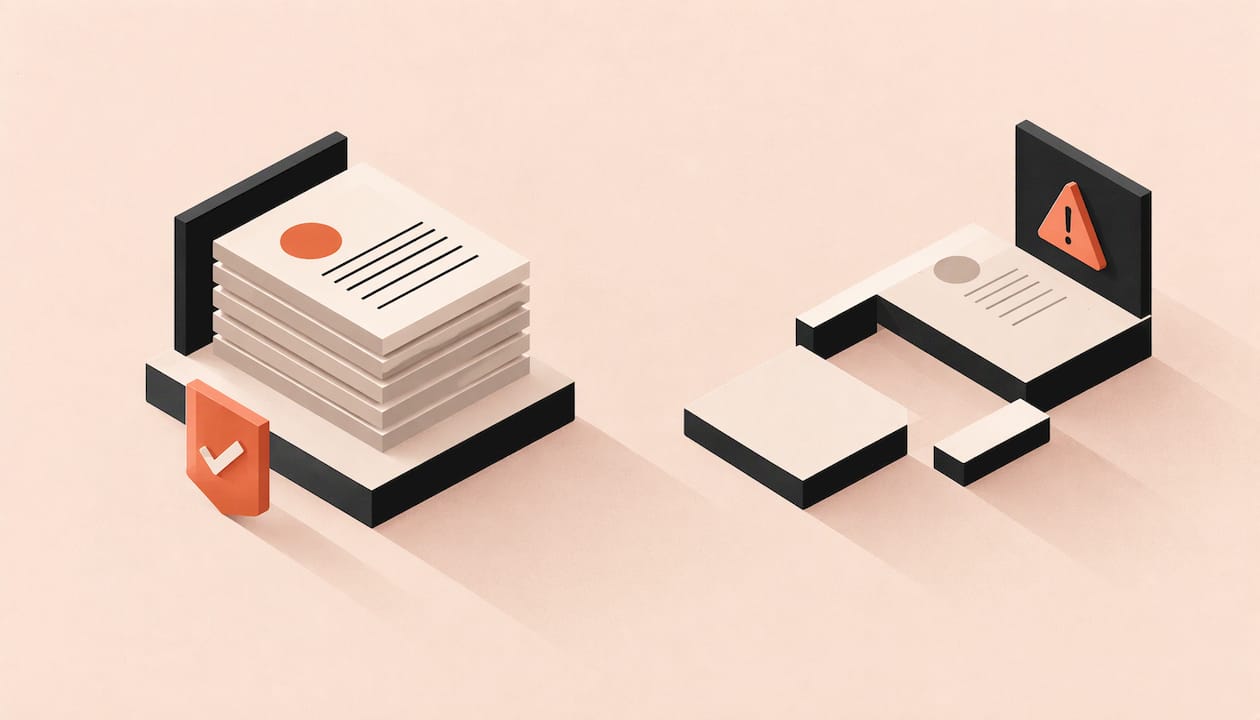
A predatory journal presents itself as a scholarly outlet while skipping the editorial and peer-review work that gives publication its meaning, and the surest way to avoid one is to check a journal's transparency before you submit anything. That means confirming who the editors are, how peer review works, what fees apply and when, where the journal is indexed and archived, and whether recognized bodies vouch for the publisher. This guide sets out those checks in the order a careful author would perform them, explains what to do if you have already submitted, and describes how independent researchers, students and established scholars can publish ethically.
TL;DR
- Predatory publishing is defined by deception and the absence of real quality assurance, not by open access or by author fees as such.
- Warning signs cluster around solicitation, vague or missing editorial information, unverifiable metrics, hidden fees and implausibly fast acceptance.
- Cross-check every journal against several independent tools (Think. Check. Submit., DOAJ, COPE, the ISSN Portal) rather than trusting a single list or a single signal.
- If you have submitted or paid, write to the editor at once, withdraw the manuscript, save correspondence and sign nothing further.
- Ethical publishing is a matter of transparent peer review, clear licensing, honest fee disclosure and long-term preservation of your work.
Table of Contents
- What predatory journals are, and what they are not
- Warning signs when you evaluate a journal or publisher
- How to verify peer review, editorial board, fees and policies
- Directories and checklists that help you identify ethical journals
- Choosing an ethical publisher: licensing, fees and archiving
- If you have already submitted or paid
- How students, independent researchers and scholars can publish ethically
- Publish with a press that documents its practices
- FAQ
- Sources
What predatory journals are, and what they are not
The Committee on Publication Ethics (COPE) describes predatory publishing as the systematic, for-profit publication of purportedly scholarly content in a deceptive or fraudulent way, without regard for quality assurance. Such publishers may charge fees without delivering the services an author expects, and COPE lists hidden or unclear fees, an absence of genuine peer review, and guaranteed acceptance or very fast publication among the common features.
The distinction matters because it protects authors from two opposite mistakes. The first is trusting a journal because it looks polished. The second is dismissing legitimate open-access publishing because some bad actors use the same vocabulary. Open access describes who can read the work; it says nothing about whether the work was reviewed. A journal is legitimate when it does what it says it does, openly and verifiably.
The consequences of getting this wrong are practical. COPE notes that deceptive journals charge authors with no intention of providing the services expected from a trustworthy publisher, so research may be published yet hard to find and at risk of being lost. The University of Edinburgh Library adds that publishing in a substandard journal can damage the reputations of both the researcher and the institution, and can undermine a research assessment submission if the problem goes undetected.
Warning signs when you evaluate a journal or publisher
No single sign is conclusive, but several together should end the conversation. The guidance from libraries and publication-ethics bodies converges on the following patterns.
Solicitation and presentation
Suspect journals tend to approach scholars directly. The NOAA Library lists email solicitations with numerous spelling or grammar errors and websites that feel outdated, low in quality or difficult to locate, or that lack an about page, contact information or affiliated organizations. COPE likewise names aggressive solicitation of authors among typical traits. Rutgers University Libraries adds "under construction" pages, missing or contradictory "About Us" information, and contact details that are absent, incomplete or unreliable.
Editorial board and identity
An editorial board that is nonsensical or nonexistent is a red flag the NOAA Library names directly. Rutgers goes further: board members who are unaware that they are listed. VCU Libraries warns about titles that mimic legitimate journals, including using another journal's ISSN. Before trusting a board, search for two or three named editors independently and confirm that their institutional pages mention the journal.
Metrics and indexing claims
Metrics that cannot be verified are a recurring problem. The NOAA Library points to claims of indexing in Scopus or Web of Science that turn out to be untrue, and Rutgers lists missing ISSNs or DOIs, invented "impact factor" variants, and false claims of DOAJ indexing. A useful caution from VCU: Google Scholar indexing is not by itself a sign of legitimacy, because Google Scholar includes articles from a wide range of journals, predatory ones among them.

Speed and process
Promises of very short peer-review or acceptance turnaround appear in the guidance from COPE, VCU and Rutgers alike. Rutgers specifically mentions review that seems to take only days and submissions accepted by email rather than through a submission system. Real peer review takes time because reviewers are experts who are not on the journal's staff and who need to read the work carefully.
How to verify peer review, editorial board, fees and policies
Warning signs tell you what to avoid; verification tells you what to trust. The Open Access Scholarly Publishers Association (OASPA) sets out principles of transparency that give you a concrete standard to hold any journal to.
- Peer review is described, not merely asserted. OASPA says peer review must be clearly described on the journal's website and defines it as advice from reviewers expert in the field who are not part of the editorial staff. Think.Check.Submit adds practical questions: does the site explain the type of peer review, whether independent external reviewers are involved, and how many reviewers read each paper?
- Editors are named and traceable. OASPA expects editors' full names and affiliations to be provided.
- Fees are stated before you submit. The same principles call for fees to be stated clearly in an easily findable place before submission. Think.Check.Submit asks what is charged, what the fee covers, when it is charged, in which currency and amount, and whether waivers exist.
- Ethics policies are visible. The transparency principles expect published policies on authorship, conflicts of interest, data sharing and reproducibility, complaints and appeals, research misconduct, intellectual property, corrections and retractions, and ethical oversight.
- Identifiers and archiving are real. An integrity checklist hosted by AcademicIntegrity.eu includes verifying the ISSN, checking indexing in the databases typical for your field, and confirming that long-term preservation is ensured.
A useful habit is to read the journal's policy pages before reading its call for papers. A journal that has written down how it handles a retraction or a conflict of interest has usually thought about the work of editing.
Directories and checklists that help you identify ethical journals
CASRAI recommends cross-checking against several purpose-built tools instead of relying on a single judgment source. It also makes a point worth remembering: a DOAJ listing is a positive signal, but absence from DOAJ is not proof that a journal is predatory. The table summarizes what each resource is good for.
| Resource | What it helps you confirm | Use it when |
|---|---|---|
| Think. Check. Submit. | A structured checklist covering peer review, fees, licensing, archiving and industry memberships | You are evaluating any journal or book publisher |
| DOAJ | Whether an open-access journal has been vetted and listed | The journal is open access |
| COPE membership | Whether the publisher belongs to a body with eligibility criteria and ethics guidance | You want an independent signal on publication ethics |
| OASPA membership | Whether an open-access publisher belongs to the association whose principles of transparency you can hold it to | The publisher is open access |
| ISSN Portal | Whether the ISSN is genuine and matches the journal's title | The ISSN looks borrowed or is missing |
| Your library's databases | Whether the journal appears in the indexes your field relies on, such as Journal Citation Reports | You need to confirm an indexing claim |
The Think.Check.Submit journal checklist specifically asks authors to confirm COPE membership, DOAJ listing for open access journals, OASPA membership for open-access publishers, and relevant regional platforms such as SciELO, Latindex, Redalyc, INASP or AJOL where they apply. The University of Edinburgh Library gives the same advice and adds a plain instruction: resist the temptation to publish quickly in any journal.
Your own librarian is the most underused resource here. Most university libraries run journal-vetting services and will answer a question about an unfamiliar title within a day or two.
Choosing an ethical publisher: licensing, fees and archiving
Avoiding bad journals is half the task; the other half is choosing a good home for your work. Think.Check.Submit frames three questions that apply to every publisher you consider.
Licensing and copyright. Is there a clear license policy, with preferred licenses stated and license details shown on published articles? Can authors retain copyright and share their work through repositories under the stated terms? You should be able to answer these from the website alone, before any contact with the publisher.
Fees. Open access does not mean a fee is necessarily wrong, but a fee must be visible. Look for the amount, the currency, the timing and the services covered. The AcademicIntegrity.eu checklist asks whether any hidden or unexplained charges arise during submission or publication. If you find a charge only after acceptance, treat that as a decisive warning.

Archiving and discoverability. Are articles indexed or archived in dedicated preservation services, is long-term preservation assured, and are permanent digital identifiers used? Work that vanishes when a publisher closes is work that has not really been published.
A short test is to imagine citing your article ten years from now. Would the DOI still resolve, would a reader find the full text, and would the license tell them what they may do with it? If any answer is uncertain, keep looking.
Our perspective on transparent publishing
We believe the most reliable protection against predatory practice is not a blacklist but an openly documented process. Authors should be able to read how peer review works, who governs the press, what ethics standards apply and how work is preserved, without writing to anyone first. That is why we publish our policies, editorial standards, governance and preservation practices for anyone to read.
We also hold that cost should never be the thing that decides whose research is heard. Pyrrhic Press Publishing is an independent publisher built around open access, and we publish scholarly works without submission or publication fees. Independent researchers, students and emerging writers often lack institutional funding, and a model that asks nothing of authors keeps the focus on the quality of the work.
Openness should also be measurable. Our 3PO Index is designed as a framework for evaluating transparency and openness in academic publishing, so that authors can compare how a platform describes itself against stated criteria. We would encourage every author to apply the same scrutiny to us as to any other publisher, using the checklists above.
the author
If you have already submitted or paid
Mistakes happen to careful people, and acting quickly limits the damage. University of Arkansas Libraries advises that if you have submitted a manuscript, you should write to the editor immediately to withdraw it, decline to pay any publishing or withdrawal fee, sign no agreements and save all correspondence. If you have already signed an agreement or paid a fee, it advises writing at once to insist that the journal not publish the work and return all rights.
Several further points from the guidance are worth knowing:
- The University of Texas Southwestern libraries caution that withdrawal can be very difficult once a manuscript is with a problematic publisher. They advise contacting your co-authors and the journal's editor and board, and paying a withdrawal fee only if you obtain specific written assurances that copyright will be returned and the work removed.
- The European Mathematical Society advises that if acceptance was surprisingly quick or reviewer reports are empty, you should re-check the journal against the criteria, and that you should avoid signing any copyright transfer.
- COPE warns that withdrawing after being misled can bring a large retraction fee, and that predatory titles on a publication list can permanently harm an academic reputation.
If you are affiliated with a university, tell your research office or librarian. They have handled this before and may know how to contact the publisher effectively. If you are unsure whether a journal belongs on your CV, discuss it with your supervisor or a senior colleague before listing it.
How students, independent researchers and scholars can publish ethically
Ethical publishing is a set of habits rather than a single decision. The following sequence works for authors at any career stage.
- Start from your field's norms. Ask supervisors, colleagues and your librarian which journals they trust, and read recent issues for work you respect.
- Shortlist, then verify. Run each candidate through the checks above: named editors, a described peer-review process, visible fees, identifiers, memberships and archiving.
- Read the author policies in full. Confirm licensing, copyright retention and what the publisher does when errors are found.
- Submit only through a proper system. A real submission platform, not a personal email address, is the norm Rutgers points to.
- Keep your own records. Save the call for papers, the policy pages as they stood when you submitted, and every message exchanged.
- Disclose and cite honestly. Declare conflicts of interest, credit contributors accurately and follow the data-sharing expectations that the journal states.
We publish guidance that supports each of these steps. Our peer review and editorial process page describes how work is reviewed, our publication ethics and research integrity page sets out the standards authors are expected to follow, and our editorial board and governance page shows who is responsible for the press. For authors preparing a first manuscript, The Nearly Universal Guide to Publishing Research offers a quick reference for citations and structure, and the Research Essentials resource library gathers further material.
Publish with a press that documents its practices
If you are looking for an open-access home where the standards are written down for you to read, Pyrrhic Press Publishing publishes scholarly research, literature and creative work without submission or publication fees. Our catalog includes more than 1,115 published works with 150,000 documented downloads, and our publishing policies and editorial standards explain what authors can expect at each stage.

Browse our journals, learn about the Free Author Spotlight, or review the 3PO Index scoring metrics to see how we approach transparency evaluation. You can start from our home page at any time.
FAQ
Is every journal that charges an author fee predatory?
No. COPE's definition turns on deception and the lack of quality assurance, not on the existence of a fee. A legitimate publisher states its fees clearly before submission, explains what they cover and when they are charged. Hidden or unexplained charges are the concern.
Does being listed in DOAJ guarantee a journal is trustworthy?
A DOAJ listing is a positive signal, and false claims of DOAJ indexing are a known red flag, so verify the claim on DOAJ itself. CASRAI notes, however, that absence from DOAJ does not prove a journal is predatory. Use DOAJ alongside COPE and OASPA membership, the ISSN Portal and Think. Check. Submit.
How can I quickly tell whether peer review is real?
Look for a published description of the review process: the type of review, whether independent external experts are involved and how many reviewers read each paper. Be wary of guaranteed acceptance or review completed in days. Real review is documented and takes time.
What should I do if an unfamiliar journal emails me to invite a submission?
Treat the email as a prompt to investigate, not as a compliment. Check the editors, fees, identifiers and memberships independently, and ask your librarian if anything is unclear. VCU Libraries advises not submitting, signing a contract or sending payment until your concerns are resolved.
Can independent researchers without an institution publish ethically?
Yes. The same checks apply to everyone: transparent peer review, named editors, clear licensing and preservation. We publish scholarly work without submission or publication fees, which is designed to make that route open to independent researchers and students.
Sources
- Predatory publishing, COPE
- Avoiding predatory publishers, COPE
- Predatory or bogus journals, University of Edinburgh Library
- Signs of a Predatory Publisher, NOAA Library
- How to Identify Predatory Journals, VCU Libraries
- Getting Start(l)ed? Predatory Publishing, Rutgers University Libraries
- Principles of Transparency and Best Practice in Scholarly Publishing, OASPA
- Principles of Transparency and Best Practice in Scholarly Publishing, WAME
- Think.Check.Submit journals checklist
- A Guide to Identifying Predatory Journals, AcademicIntegrity.eu
- How to Identify Predatory Journals and Publishers, CASRAI
- Withdrawing Work from a Predatory Journal, University of Arkansas Libraries
- Retracting Your Article, UT Southwestern Medical Center Libraries
- On Predatory Publishing, European Mathematical Society