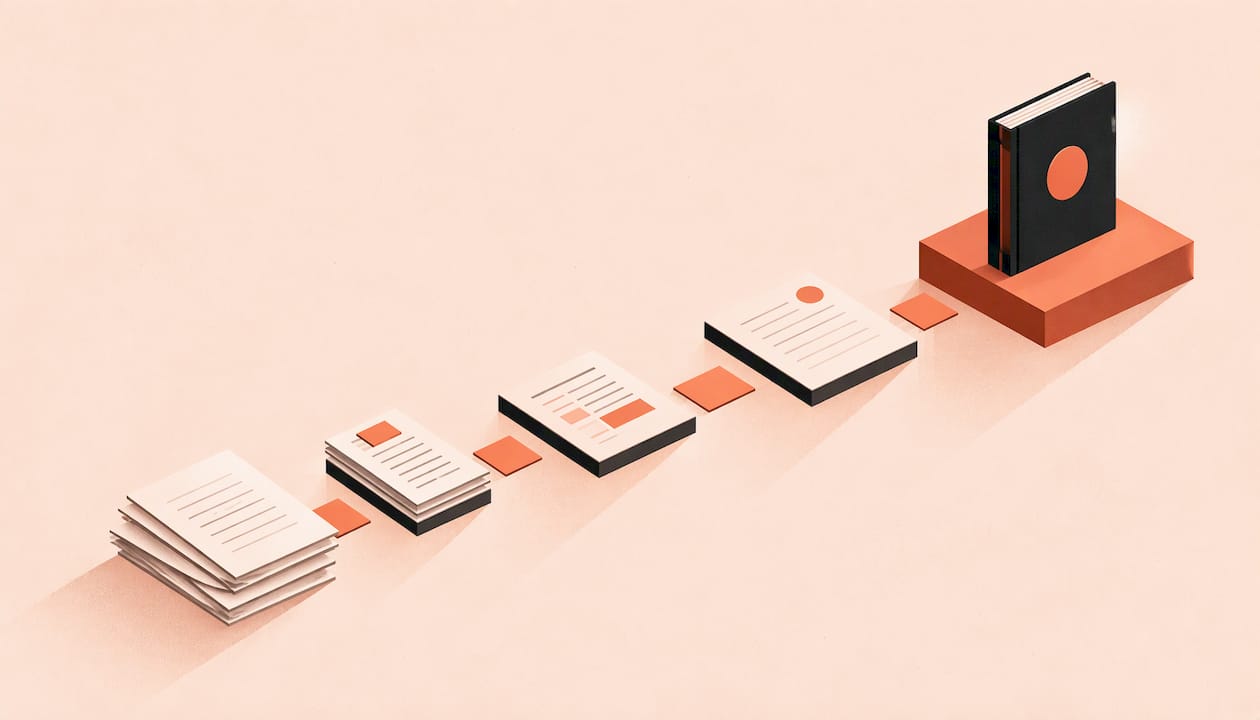
Publishing a research paper means preparing a manuscript in the standard structure of your field, choosing a journal whose scope and policies fit it, submitting it for editorial screening and peer review, revising in response to reviewers, and seeing the accepted version released with clear rights and a permanent address. You do not need an institution to do this, and you should not need to pay to be considered: at Pyrrhic Press Publishing, scholarly works are published without submission or publication fees, and independent researchers, students, scholars and writers are welcome to submit.
This guide follows the path in order, explains each term where it first appears, and shows where authors most often lose time.
TL;DR
- Write in the structure your field expects (for most empirical work, Introduction, Methods, Results, Discussion) and make the title and abstract searchable.
- Choose the journal before you finalize the manuscript: check scope, article type, peer review, rights and any fees.
- Expect editorial screening, peer review and at least one round of revision; a reject-and-resubmit decision is a normal outcome, not a verdict on your work.
- Independent researchers and students can publish without an affiliation, and a repository deposit makes work publicly available while you wait.
- Pyrrhic Press Publishing publishes scholarly work with no submission or publication fees.
Table of Contents
- Step 1: Prepare the manuscript
- Step 2: Choose where to publish
- Step 3: Submit with a cover letter
- Step 4: Editorial screening and peer review
- Step 5: Revise and respond to reviewers
- Step 6: Production, rights and publication
- Can you publish independently?
- Writers and creative scholars
- Where Pyrrhic Press fits
- FAQ
- Sources
Step 1: Prepare the manuscript
Most research articles in the sciences and social sciences follow the IMRAD structure: Introduction, Methods, Results and Discussion. UC Berkeley's library guide describes it as a common article format and advises using terms in the title and abstract that a reader would actually type into a search engine. The same guide explains the logic of each part: the methods should give enough detail for another researcher to reproduce the work, the results report what you found, and the discussion explains what it means and why it matters.
Humanities and literary scholarship often follow a different shape, such as an argument built across sections with a close reading at its center. The rule that holds across fields is to follow the conventions of the journals you intend to read and cite.
Before drafting is finished, settle several matters that are painful to fix later. The University of Michigan Library's Scholarly Publishing Toolkit covers them in sequence: your publication goals, who qualifies as an author, whether to preregister a study (record its plan publicly before collecting data), a data management plan, and manuscript preparation. Agreeing on authorship order and contributions with collaborators early prevents disputes at submission.
A practical checklist before you move on:
- A title that states the subject and, where possible, the finding.
- An abstract that stands alone, with the question, method, main result and significance.
- References formatted consistently and every citation traceable.
- Data, code or source materials organized so they can be shared or described.
- Disclosures of funding and any conflicts of interest, meaning relationships that could reasonably be seen as influencing your work.
Step 2: Choose where to publish
Select the outlet before the final polish, because journals differ in length limits, reference style and article types. The University of North Carolina at Chapel Hill advises weighing relevance to your topic, the article types accepted, the intended audience, whether peer review is used, discoverability, reputation, public-access requirements from funders, open-access options and fees. Johns Hopkins University's guide adds editorial practices, author rights, and whether fees are clearly disclosed.
A workable approach is to list five journals, read two or three recent issues of each, and compare them against your paper on these questions:
- Scope: do published articles resemble yours in subject and method?
- Audience: are the readers you want to reach the ones the journal serves?
- Review model: is the peer review process described, including whether it is anonymous?
- Rights: do you keep your copyright or license your work openly?
- Cost: are all fees stated on the website, with no surprises?
Open access means the finished article can be read by anyone, free of charge. For an independent researcher or a student without library access, it is also the format that makes your work findable by people outside a university. Our journals publish scholarly work in open access, and our publishing policies and editorial standards set out what we expect from submissions.
Checking fees and legitimacy
A journal's legitimacy is part of choosing it. Canada's Secretariat on Responsible Conduct of Research publishes a checklist for identifying predatory publishers. Its points are practical: article processing charges (APCs), the fees some journals charge to publish an accepted article, should be due after acceptance and before publication, never before peer review begins; fees should be set out clearly on the journal's website; unusual charges such as "handling fees" deserve attention; and any claimed membership of bodies such as COPE (the Committee on Publication Ethics) or DOAJ (the Directory of Open Access Journals) should be verified on those bodies' own listings. Copyright transfer typically happens after acceptance, and most open-access journals apply a Creative Commons license, under which authors often keep their copyright.
For more on this, see our guide to avoiding predatory journals and publishing ethically and our position on charging for research submissions.

Step 3: Submit with a cover letter
Most journals use an online submission system. Following the journal's author instructions exactly is the cheapest way to avoid an early rejection: word limits, anonymized files, figure formats and reference style are all checked at the first stage.
The cover letter is short. It names the paper, states in two or three sentences what it contributes, explains why the journal's readers would care, and confirms that the work is not under consideration elsewhere. It should also declare any conflicts of interest and, where relevant, ethics approvals for work involving people or animals.
Step 4: Editorial screening and peer review
According to UC Berkeley's description of the editorial process, a submission receives a tracking ID and then goes through preliminary editorial screening, in which an editor reads the cover letter, title and abstract. Papers outside the journal's scope are either recommended for transfer to a better-suited journal or rejected at this point. Papers that pass are sent to reviewers, who are independent experts in the subject.
Reviewers typically recommend one of four outcomes: accept without changes (uncommon), accept with minor revisions, accept with major revisions, or reject. The editor then decides, and the decision usually falls into one of these categories:
| Decision | What it means | What you do |
|---|---|---|
| Acceptance | The paper is accepted as submitted or after small corrections | Proceed to production and proofs |
| Conditional acceptance, minor revisions | The editor checks your changes | Make the edits and explain them |
| Conditional acceptance, major revisions | Reviewers will see the revised paper again | Revise and send a detailed point-by-point response |
| Resubmission invited | The current version is not accepted, but a substantially revised one may be | Resubmit with a letter that references the earlier submission |
| Rejection | The journal will not publish this paper | Submit elsewhere, using the feedback |
Peer review is best understood as a method for strengthening scholarship: a second and third informed reading before the work becomes part of the record. You can read how our own process works on the peer review and editorial process page.
How long it takes
Timelines vary widely by field and journal. Expect weeks for the editor's first decision, a longer stretch for reviewers, and further time for revision and production. Anything quoted as a universal figure should be treated with caution; the journal's own page usually states its typical turnaround, and that is the number to plan around.
Step 5: Revise and respond to reviewers
Revision is where many papers are won. A strong response letter follows a simple pattern:
- Thank the editor and reviewers briefly.
- Quote each comment, then answer it directly beneath.
- State exactly what you changed and where (page and line).
- When you disagree, say so politely and give your evidence.
- Highlight changes in the manuscript so the editor can verify them quickly.
A comment you disagree with is still information: if one reader misunderstood a point, others might as well, and a clarifying sentence often resolves it. If the outcome is rejection, read the reviews, fix what is fair, and submit to the next journal on your list. A rejection from one journal ends that submission, not the paper.
Step 6: Production, rights and publication
After acceptance you will usually sign a publishing agreement or select a license, check proofs for errors, and approve the final version. Read the rights terms carefully: they determine whether you can post the article, reuse figures in later work or share it with students. Publication practices such as persistent identifiers and metadata (the descriptive information that lets databases index your paper) matter for discoverability; ours are described under research preservation, metadata and publication practices. Ethical expectations, including authorship, data integrity and disclosure, are set out in our publication ethics and research integrity standards.
Can you publish independently?
Yes. Independent researchers, graduate students and undergraduates publish in peer-reviewed journals without an institutional affiliation; you list your name, a contact address and, if you have one, an ORCID iD (a free persistent identifier for researchers). What editors and reviewers evaluate is the question, the method and the evidence.
The practical difficulties for independents are access and visibility, not eligibility. Without a library subscription it is harder to read the literature you need to cite, and without an institutional repository it is harder to share your work. Two responses help:
- Choose open-access venues, so your own paper is readable by everyone.
- Deposit in a repository. Harvard's Open Access Project notes that researchers without an institutional or disciplinary repository can use a universal repository such as Zenodo, which provides digital preservation and persistent URLs, and is better indexed by search engines than a personal website. It also advises depositing at acceptance, when you hold the peer-reviewed manuscript.
Students have an additional first step: ask your advisor or instructor to read the draft, since their comments often resemble what a reviewer would raise.
Writers and creative scholars
If your work is literary, such as poetry, essays or spoken-word performance, the path is similar but the conventions differ: submission guidelines focus on genre and length, and review looks at craft as well as argument. We publish books, poetry and spoken-word performances alongside scholarly journals, and the Author Spotlight gives authors a place to present their work to readers.
Where Pyrrhic Press fits
When the choice of outlet is the hard part, the fee question is usually the first filter. Pyrrhic Press Publishing is an independent open-access publisher with no submission or publication fees, which means an independent researcher or student can submit without budgeting for charges. Our catalog includes more than 1,115 published works with 150,000 documented downloads, and every work is free for readers. You can start from our journals page, see how earlier authors fared in our publishing and scholarly research case studies, or go straight to the Pyrrhic Press site to submit.

We also maintain the 3PO Score Index, a framework for evaluating the transparency and openness of academic publishing platforms. Its scoring metrics give you criteria to apply when you compare any journal on your shortlist.
Our perspective
We built Pyrrhic Press Publishing on the conviction that a good paper should reach readers regardless of who wrote it or what funding stood behind it. For that reason, we publish scholarly works without submission or publication fees, and we ask authors for rigorous work and honest disclosure rather than payment.
In our experience of the process as a publisher, authors do best when they treat publication as a conversation: a clear submission, a careful reading by reviewers, a thoughtful revision. That is why our peer review and editorial standards are public, and why the 3PO Index exists, so that authors can judge the transparency of any platform before they entrust it with their work.
Independent researchers, students and emerging writers are the voices we most want to hear. Open access, a free scholarly association and an international readership are how we try to give them visibility and engagement.
the author
FAQ
How do I publish a research paper for the first time?
Write the paper in your field's standard structure, choose a journal whose scope and policies fit, and submit through its online system with a short cover letter. Expect editorial screening, peer review and likely one round of revisions before acceptance. Ask an advisor or colleague to read the draft first.
Do I need a university affiliation to publish?
No. Journals judge a paper on its question, method and evidence, and you can submit as an independent researcher with your own name and contact details. An ORCID iD helps identify you. Choosing an open-access venue and depositing the work in a repository increase your visibility without an institution behind you.
How can I tell whether a journal is legitimate?
Look for clearly stated fees, a described peer review process and an editorial board you can verify. Fees should fall due after acceptance, not before review. Confirm any claimed membership of COPE or DOAJ on those organizations' own sites, using the checklist from Canada's research ethics secretariat.
What happens if my paper is rejected?
Rejection ends that submission, not the paper's prospects. Read the editor's and reviewers' comments, correct genuine weaknesses, and submit to the next journal on your list. If the decision invites resubmission, revise substantially and include a letter referring to the original submission.
Can I publish without paying fees?
Yes. Pyrrhic Press Publishing charges no submission or publication fees. Whichever outlet you choose, check the journal's website for a full statement of costs before you submit.
Sources
- UC Berkeley Library: Writing the paper
- UC Berkeley Library: Editorial process
- University of Michigan Library: Scholarly Publishing Toolkit
- UNC Chapel Hill Libraries: Choose where to publish
- Johns Hopkins University Libraries: Choosing a journal
- Harvard Open Access Project: How to make your own work open access
- Government of Canada: Identifying predatory publishers checklist
Recommended
- How to Disseminate Research Findings: A Practical Guide
- Where Are You Headed? Get There. ISSUE 2 - The Ultimate Quick Reference Guide to Publishing Success: From Manuscript to Global Impact
- Publishing Policies and Editorial Standards
- The Nearly Universal Guide to Publishing Research + Quick Reference Guide for Citations and Structure