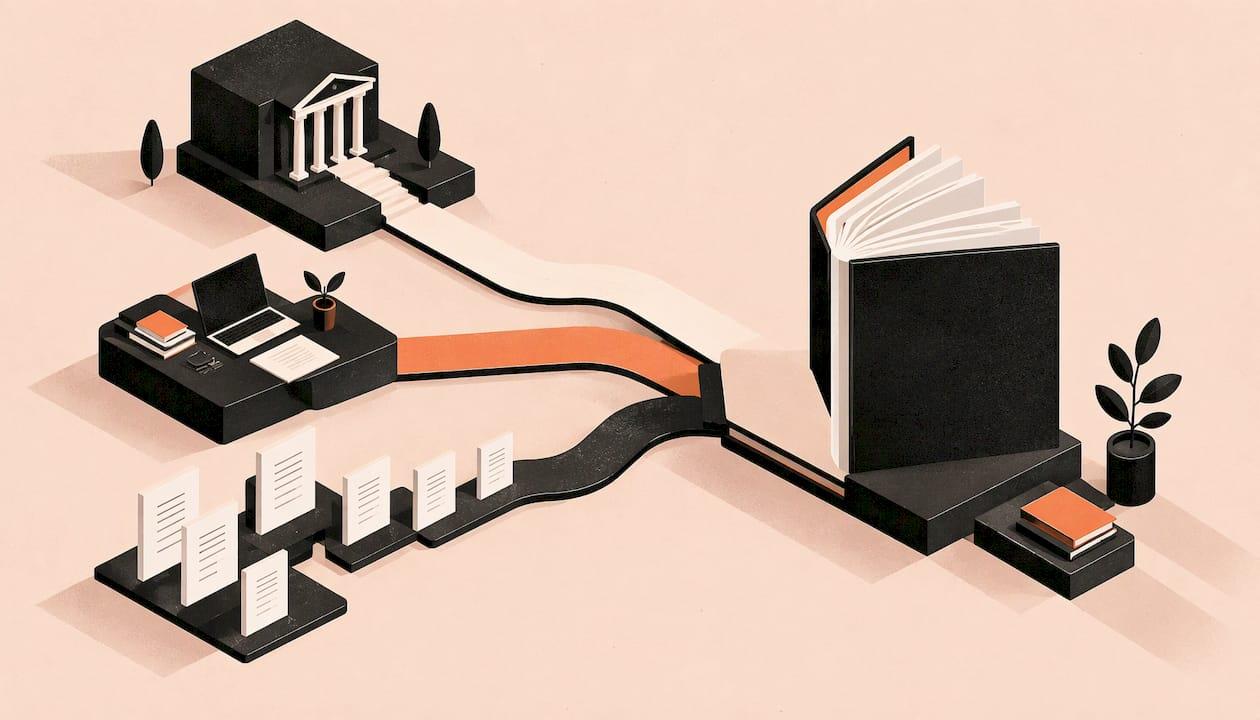
A poetry collection reaches readers by one of three routes: a press accepts it, a contest selects it, or you produce it yourself. The route that suits you depends on what you want the book to do, whether that is to build a record of publication, reach readers freely, or sit alongside scholarly work. If your priority is to be read without paying anything, an open-access publisher with no submission or publication fees, such as Pyrrhic Press Publishing, is the most direct place to begin. The rest of this guide explains how each route works, what it costs, and what to check before you sign anything.
TL;DR
- Prepare a clean, consistently formatted manuscript first, and read each press's guidelines before you send it.
- Traditional presses do not ask authors to pay production costs, so a request for such payment is a signal to look more closely.
- Contests usually charge entry fees and select one book; open reading periods are often cheaper and may take several.
- Copyright in your poems is yours; what you grant a publisher is specific rights, so read the contract.
- Pyrrhic Press Publishing publishes with no submission or publication fees, which suits independent poets, students and scholars.
Table of Contents
- The main routes to a published collection
- Prepare the manuscript before you submit
- Presses, contests and open reading periods
- Publishing poetry for free: what is free and what is not
- Rights, copyright and what a contract should say
- Open access: a route for scholars and independent poets
- Where Pyrrhic Press Publishing fits
- Perspective
- Publish your collection with no fees
- A realistic order of work
- FAQ
- Sources
The main routes to a published collection
Poets.ca, the Canadian poetry association, describes three broad paths: traditional publishing, in which you submit a manuscript to a publisher or agent for consideration; self-publishing, in which you produce the book without outside vetting, either alone or with paid assistance; and publishing individual poems in journals, which builds a portfolio and connects you with people in the poetry world.
The three are not exclusive. Most collections are assembled from poems that first appeared elsewhere, and a record of journal publication is what many presses look for. A reasonable sequence for most poets is to publish individual poems, assemble the collection, then approach presses or open reading periods.

The difference between publishing a poem and publishing a collection is one of structure. A journal asks whether a single poem works. A press asks whether sixty poems add up to a book, with an arc, recurring concerns and an order that rewards reading from front to back. That second question is the one you are preparing to answer.
Prepare the manuscript before you submit
A press will judge your manuscript partly on how professionally it is presented. MasterClass's formatting guide recommends the following conventions:
- Proofread the whole manuscript.
- Start each poem on a new page.
- Single-space lines and double-space between stanzas.
- Use one-inch margins and a serif font.
- Number the pages and include a title page.
The same guide notes that a press may ask for a complete manuscript, a packet of selected poems, or a query letter, so the guidelines of the specific press override any general rule.
How long should a collection be?
There is no universal length, but the conventions are fairly stable. According to the Poemfactotum guide, a chapbook is normally under 40 pages and a full-length book is usually at least 48 pages, sometimes more than 100. One poem per page is standard, except for very short forms.
If you have fewer poems than a full-length book needs, a chapbook is a legitimate first book, not a lesser one.
Previous publication
Many publishers look for a share of the manuscript to have appeared in journals or magazines. The Telltell Poetry guide puts this at roughly 25 to 50 percent of a chapbook or full-length manuscript. Treat that as a common expectation rather than a rule, and note that it varies by press. It is one more reason to send individual poems out while the collection takes shape.
Order and fit
Read what a press has already published before you submit. Each press has its own aesthetic, and the same Telltell guide advises researching fit first. Poets & Writers adds a practical step: read the submission guidelines, which state whether a press accepts unsolicited manuscripts or only agented ones, and whether editors want a full manuscript, sample poems, a query letter or a proposal. If the press accepts postal submissions, include a self-addressed stamped envelope for the reply.
Presses, contests and open reading periods
The choice among these is mainly a choice about money, odds and visibility.
| Route | Typical cost to you | What to expect |
|---|---|---|
| Press with open reading period | Often no fee or a modest one | May be capped; some presses accept several collections |
| Book contest | Entry fees, usually $20 to $40 | Usually one winning collection per contest, with a prize |
| Self-production | Costs of editing, design, proofs | You keep all rights and take on all production work |
| Open-access publisher with no fees | None to the author | Free to read worldwide; discoverability depends on your own sharing |
The contest figures come from Writers.com, which reports entry fees typically between $20 and $40, prizes from $500 to $10,000, and usually one collection selected per contest. The same page notes that open reading periods are typically cheaper, may be capped, and often take multiple collections.
Writer's Digest advises setting your own criteria before submitting, for example a publisher that makes well-designed books and specializes in poetry, and trying open submission periods without reading fees before entering contests.
Track what you send
Contests multiply quickly. Keep a simple record of each submission: the press or contest, the date, the fee, the judge, the word or page limits and whether simultaneous submissions are allowed. MasterClass flags the same details. If a book is accepted elsewhere while it is under consideration, you will need to withdraw it from the others promptly, which is only possible if you know where it is.
Publishing poetry for free: what is free and what is not
People searching for free poetry publishing usually mean one of two things: no fee to submit and publish, or no cost at all to produce a finished book. They are different.
A publisher that charges nothing to submit or publish removes the largest barrier. Poets.ca states that traditional publishers do not ask authors to pay production costs, though authors may buy extra copies of their own book, usually at a 40 percent discount. It adds that a request for production costs may indicate assisted self-publishing. Poemfactotum is blunter about the extreme end of that spectrum, warning that vanity presses publish at the author's expense, charge far more than production costs, and have no credibility with reviewers or distributors.
If you instead produce the book yourself, the platforms themselves may cost nothing to use, but a polished book still needs editing, a cover, formatting and proof copies. The University of Arizona's guide stresses that with self-publishing the author's responsibility shifts to production costs, marketing and editing, including copyediting. It also points out that self-publishing has a long history in poetry: Walt Whitman self-published the first edition of Leaves of Grass.

So the honest answer is this: free publication is available where the publisher carries the production, and free listing is available where you carry it. Choose according to how much of that work you want to do yourself.
Questions to ask any publisher about cost
- Is there any fee at submission, acceptance or production?
- If I want copies of my own book, at what price?
- Who pays for design, typesetting and distribution?
- Are marketing services sold to authors, and are they optional?
A press that answers all four plainly, and with no charge to the author, is operating in the way Poets.ca describes as traditional.
Rights, copyright and what a contract should say
You own the copyright in your poems from the moment you write them. The University of Arizona's guide states that whether you self-publish, traditionally publish, or never publish, you own copyright in all your written work; publishing generally means assigning some rights to the publisher, while self-publishing means you keep all reproduction and distribution rights yourself.
Three practical points follow.
- Rights are specific. Journals often ask for First North American Serial Rights, which, as Writers.com explains, grant exclusive first-publication rights without taking ownership of the poem. Know which rights a contract covers, and for how long.
- Registration is optional. The same source notes that poems in books or online are automatically protected, and that registering with the U.S. Copyright Office is a paid service that mainly makes sense for self-printed, self-distributed work.
- Check reversion. Ask what happens if the book goes out of print or the press closes: whether and how the rights return to you.
For a contract dispute or a question about your legal position, a literary or intellectual-property attorney is the right person to consult.
Open access: a route for scholars and independent poets
Open access means the work is free for anyone to read online. For poets working in or near the academy, such as students, independent researchers and scholars who write creatively or study poetics, this matters because it removes the paywall between the work and its audience.
Institutional presses handle open access in different ways. The Finnish Literature Society, for instance, publishes its scholarly series as open-access e-books with permanent DOIs and charges an open-access fee only to projects with earmarked funding, never to individual researchers. Other university presses ask for substantial fees: Manchester University Press lists £9,850 plus UK VAT for an open-access monograph, and the TOME initiative offers grants to eligible authors at participating institutions whose presses then produce a Creative Commons edition. Those routes assume an institution or funder behind you.
Independent poets and early-career writers often have neither. This is the gap that a no-fee open-access publisher fills.
Where Pyrrhic Press Publishing fits
Pyrrhic Press Publishing is an independent publisher of open-access research, literature and creative expression, with journals, books, poetry and spoken-word performances. Its core commitment is to publish scholarly and literary work without submission or publication fees. Its site reports more than 1,115 published works and 150,000 documented downloads.
For a poet, that means three practical things:
- No fee at submission and no fee at publication.
- A worldwide readership, because the work is open to read.
- A publisher that treats literature and scholarship as part of the same conversation, which suits poets who also write criticism or research.
To see how work is accepted, start with the submissions page and the submission template. The publishing policies and editorial standards explain how work is handled, and the guide to avoiding predatory journals is useful for anyone checking whether a publisher charges for credibility it cannot deliver.
Perspective
Poetry has never needed a toll booth. A poem is finished when it is good, and a collection is finished when its order makes sense; neither of those facts depends on the author's ability to pay a fee.
We built Pyrrhic Press Publishing around that idea. Authors pay nothing to submit and nothing to publish, and readers pay nothing to read. We treat open access as a way of strengthening scholarly and literary work by letting more people reach it, respond to it and cite it.
For independent poets, students and scholars who do not have an institution or grant behind them, this removes the first and largest obstacle. What remains is the work itself: a coherent manuscript, a considered order, and a clear sense of who the book is for. We would rather spend our attention there.
the author
Publish your collection with no fees
If you are ready to share a collection, or want to introduce yourself to readers first, Pyrrhic Press Publishing offers open-access publishing with no submission or publication fees, along with a free Author Spotlight for writers who want visibility for their work. Begin on the Pyrrhic Press Publishing site and follow the submission instructions there.

The PULSE association's free webinar series is also open to writers who want to learn more about scholarly communication alongside their creative work.
A realistic order of work
For a first collection, the following sequence keeps effort proportionate to results.
- Gather and sort. Collect your strongest poems and look for the threads that connect them. Remove poems that do not serve the arc, however much you like them individually.
- Publish individual poems. Send poems to journals to build a record, tracking each submission.
- Order and format. Arrange the poems deliberately, then apply the formatting conventions above.
- Choose a route. Match your goals to the table: open reading periods and no-fee open-access publishers if cost and reach matter most; contests if the prize and prestige matter and you can afford the fees.
- Read the guidelines, then submit. Send exactly what is asked for, in the format asked for.
- Read the contract. Confirm the rights granted, the duration, the copies available to you and what happens if the book goes out of print.
- Share the book. Readings, social media, and your own network matter on every route, because no publisher can replace them.
FAQ
Can I publish a poetry collection without paying anything?
Yes, if the publisher carries the production. Traditional presses do not ask authors to cover production costs, and a no-fee open-access publisher such as Pyrrhic Press Publishing charges nothing at submission or publication. You may still choose to spend on proofreading or on your own copies.
Do I need an agent to publish poetry?
Usually not. Many poetry presses read manuscripts directly during open reading periods or contests, though each press states in its guidelines whether it accepts unsolicited work or only agented submissions. Read the guidelines before you send anything.
Should I publish individual poems before a collection?
It helps. Many publishers look for a share of the manuscript to have appeared in journals, with figures around 25 to 50 percent mentioned in practitioner guides. Individual publications also show editors that other readers have valued your work.
Who owns the rights to my poems once they are published?
You own the copyright. Publishing generally means granting the publisher specific rights, such as first serial rights or the right to print and distribute the book. Read the contract for which rights, for how long, and how they revert to you.
How long should a poetry collection be?
A chapbook is normally under 40 pages and a full-length collection usually at least 48, sometimes over 100. Each press sets its own requirements, so check the guidelines before you assemble the final manuscript.
Sources
- Publishing Poetry (Poets.ca)
- Alternatives to Traditional Literary Publishing (University of Arizona Libraries)
- How to Format and Submit Your Poetry Manuscript (MasterClass)
- Publishing Your Book (Poets & Writers)
- How to publish a full-length poetry collection (Telltell Poetry)
- Publishing Your Book of Poetry (Poemfactotum)
- How to Get Poetry Published (Writers.com)
- Assembling and Submitting a Poetry Collection (Writer's Digest)
- Submit a manuscript (Finnish Literature Society)
- Open Access Books (Manchester University Press)
- Authors (TOME)