
Most dissertations are published in one limited sense and unpublished in another. Nearly every doctoral program in the United States requires you to deposit the finished work in a database or repository, where it becomes available to readers. That deposit is not the same as a journal article or a scholarly book, which have gone through editorial and peer review and reach a much wider audience. The practical path for most authors is to keep the archived copy and then adapt the strongest chapters into articles, a book, or an open-access publication that people will actually find and cite. At Pyrrhic Press Publishing we publish scholarly work with no submission or publication fees, which makes the second step open to independent researchers and students as well as to funded faculty.
TL;DR
- A dissertation counts as "published" in the reference sense once it sits in a database such as ProQuest, an institutional repository, or an archive. That is distribution, not peer-reviewed publication.
- Not every dissertation is archived publicly, but most universities require deposit, and you can often choose an embargo that delays full-text access.
- Dissertations are examined by a committee, not peer reviewed like journal articles, so turning chapters into articles or a book is a separate, worthwhile step.
- Most major publishers do not treat a repository thesis as prior publication, though you should check each journal's policy and tell the editor the work comes from your thesis.
- Open-access publishing without author fees lets you reach readers beyond your university's repository.
Table of Contents
- What "published" means for a dissertation
- Are all dissertations published?
- Are dissertations peer reviewed?
- Why publishing beyond the repository still matters
- Will a journal or press accept work from my dissertation?
- How to get a dissertation or thesis published: a step-by-step path
- Journal article, book, or open-access platform?
- Literary and creative dissertations
- How Pyrrhic Press fits in
- FAQ
- Sources
What "published" means for a dissertation
The word carries two meanings, and search results blur them. In citation practice, a dissertation or thesis is treated as published when it is available from a database such as ProQuest Dissertations and Theses Global or PQDT Open, an institutional repository, or an archive. If your work is in one of those places, you cite it as published and others can cite yours the same way.
In the scholarly-communication sense, publication means that a journal or press has reviewed your work, edited it, assigned it an identifier, and made it part of the record readers search. A dissertation deposit does none of that. The deposited file is the version your committee approved, often a hundred pages or more, in the format your graduate school required.
So when someone asks whether dissertations are published, the accurate answer is: they are usually archived and discoverable, and a minority later become articles or books. Which of those outcomes you want determines what you do next.
Are all dissertations published?
Not in every case, but at most research universities deposit is part of earning the degree. The University of North Carolina at Chapel Hill, for example, states that all theses and dissertations are included in the ProQuest database and the university library database and made available to the public over the Internet. Each student grants the university a limited, non-exclusive, royalty-free license, and the author keeps ownership.
Northwestern University works in a similar way. Its Graduate School requires graduating PhD students to upload dissertations to ProQuest and the institutional repository, states that student authors own the copyright, and allows an embargo that restricts online access while the metadata stays visible.
The pattern repeats outside the United States:
- At TU Delft in the Netherlands, doctoral candidates must make a digital version available for the Open Access repository, and if a chapter is embargoed because of a publisher, the whole dissertation is embargoed.
- At the University of Kent in the United Kingdom, authors deposit under a non-exclusive licence and keep copyright. They may choose a Creative Commons licence or request a one- or three-year embargo.
- At James Cook University in Australia, theses are deposited as open access for worldwide dissemination, and embargoes of 12 months or more are granted only in compelling circumstances.
The details differ by institution, so read your own graduate school's guide. Master's theses and undergraduate dissertations follow local rules: some departments archive them, others keep them in a department folder that outsiders never see.
Are dissertations peer reviewed?
A dissertation is evaluated, but not in the way a journal article is. A dissertation is not the same thing as a peer-reviewed journal article: it is examined by a committee the candidate usually knows well, and it is not subject to the anonymized review conventions that govern journal publishing. The committee's approval and the defense certify that you have met the requirements for the degree.
That distinction is useful rather than discouraging. Committee feedback gives you a stronger draft, and external peer review then tests the work against a wider field. Editors also know the difference, which is one reason an article based on a dissertation is judged as a new submission and not as a repeat of something already vetted.
Why publishing beyond the repository still matters
A repository copy is discoverable if someone searches for your exact topic or title. It rarely reaches the readers who browse journals, follow editors, or read a book series. It also lacks the signals that hiring committees and funders look for: a peer-reviewed article, a citation record, a named venue.
There is also a practical reason. Dissertations are long and structured around the requirements of a degree: an extended literature review, a methods chapter written for examiners, and appendices. Readers in the field want the contribution in a form they can absorb in an afternoon. Rewriting for that audience is what makes the work usable by others.
For independent researchers, students, and writers working outside a university, the same logic applies with extra force. If your thesis lives in a repository you no longer have access to, or never had one, a separate open-access publication gives your work a permanent public home.
Will a journal or press accept work from my dissertation?
The fear that a repository copy blocks later publication has largely faded. The University of Melbourne's library notes that it is now very rare for publishers to reject work that appeared online as a thesis or preprint, and it cites the Committee on Publication Ethics (COPE), the body that sets common standards for editors. COPE's 2017 position is that a thesis containing otherwise unpublished work should not count as prior publication.
Durham University's guide quotes COPE's wording, last reviewed in October 2024: a thesis consisting solely of unpublished work may be subsequently published whether or not it is freely available in a repository or carries a Creative Commons licence. The University of Regensburg likewise notes that most publishers exclude dissertations from prior-publication concerns.
Editors and presses are receptive as well. The University of Washington Libraries reports on surveys in which about 80% or more of journal editors would always welcome or consider case by case submissions based on open-access dissertations, with a similar share of university presses willing to consider a book.
Two cautions keep you safe. First, a few publishers still ask for exclusive rights, and the Melbourne guidance points out that authors may not be able to assign rights the university's open-access licence already covers. Second, the rule applies to unpublished work. If a chapter already appeared as an article during your doctorate, the reuse conditions of that article govern, not the thesis rules.
How to get a dissertation or thesis published: a step-by-step path
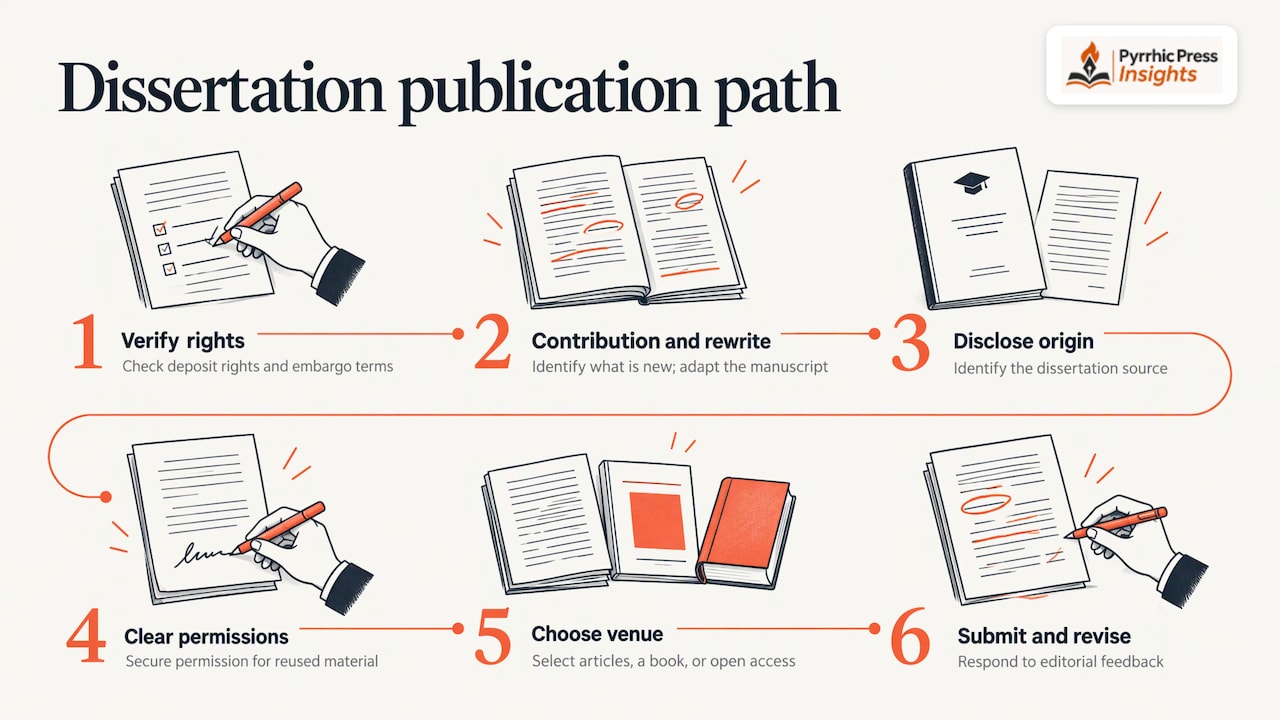
The route below applies whether you are aiming for articles, a book, or an open-access venue.
1. Confirm what you own and what is embargoed
Start with your deposit agreement. In most of the policies above, you keep copyright and the university holds a non-exclusive license. Note whether you chose an embargo and when it ends. Some institutions embargo the full text when a publisher is involved, so tell your graduate school if you expect a book contract.
2. Decide what the publication unit is
A dissertation rarely maps to a single article. Look for the self-contained contributions: a literature synthesis, a dataset or method, an empirical finding, a case study. Each should answer one question that a reader outside your committee cares about. A humanities dissertation often becomes one book plus one or two articles drawn from chapters that stand alone.
3. Rewrite for a new reader
Cut the elements that existed for examiners: the exhaustive review, the defense of every methodological choice, the long preliminaries. Lead with the finding. Update the literature, since months or years may have passed. Rebuild the abstract and title so they work in a database search. A quick walk through the standard stages appears in our guide on how to publish a research paper, and the Nearly Universal Guide to Publishing Research gives a quick reference for citations and structure.
4. Check the target's policy and disclose the origin
Look up the journal's self-archiving policy on SHERPA/RoMEO, a database of publisher policies, and tell the editor in your cover letter that the work is part of a thesis. The University of Washington guide notes that an editor may in some cases ask you to delay open access. Disclosure is what keeps the process smooth, since editors prefer to hear it from you.
5. Clear permissions and third-party material
Figures, long quotations, survey instruments, and interview material may need permission before they go into a new publication. If your project used recorded lectures or sessions, review the rules on recording lectures legally in the U.S. so that your use of that material stands on solid ground. If you chose a Creative Commons licence for the thesis, the Regensburg library recommends CC BY so the public can distribute and build on the work; keep the same licence in mind for later versions.
6. Choose a venue that fits your readers and your budget
Weigh the audience, the review process, the indexing, and the cost to you. Some outlets charge authors processing fees, and some are predatory. Our article on how to avoid predatory journals lists the warning signs, and the 3PO Score Index is our framework for evaluating transparency and openness in academic publishing platforms.
7. Submit, revise, and share
Expect revision requests; they are a normal part of peer review and usually strengthen the argument. After acceptance, extend the reach of the work through preprint servers, social channels, and scholarly associations. Our practical guide to disseminating research findings covers this stage.
Journal article, book, or open-access platform?
| Route | Best for | What to prepare |
|---|---|---|
| Journal articles | Empirical or theoretical findings that stand alone, in STEM and social sciences | A focused 6,000 to 9,000 word manuscript per contribution, with updated literature |
| Scholarly book | Humanities and qualitative work with a sustained argument | A proposal, a revised table of contents, and a rewrite of the opening and conclusion |
| Open-access platform with no author fees | Independent researchers, students, and writers who want a public, citable home for their work | A manuscript polished for readers, with clear metadata and cleared permissions |
The word range in the journal row is a common planning figure and varies by field and journal; the author guidelines of your target journal set the real limit.
Literary and creative dissertations
Writers completing a creative thesis, such as a poetry collection or a novel excerpt with a critical essay, face the same two layers. The deposit copy sits in the repository, while a published collection or essay finds readers through literary channels. The creative component often needs the least restructuring: choose the strongest poems or sections, order them for a reader instead of an examiner, and submit them to a venue that publishes literature. Pyrrhic Press publishes poetry and spoken-word performances alongside scholarly work, so scholarly and creative authors can find a place for the same project.
How Pyrrhic Press fits in
Pyrrhic Press Publishing is an independent publisher of open-access research, literature, and creative expression. We publish scholarly works without submission or publication fees, and our catalog includes more than 1,115 published works with 150,000 documented downloads. For an author with a finished dissertation, that means you can submit adapted chapters or a revised manuscript without finding funds for an article processing charge.
The standards behind the process are public: our publishing policies and editorial standards, publication ethics and research integrity page, and research preservation, metadata, and publication practices explain what to expect before you submit. Authors who want a public profile can also look at our free Author Spotlight, and the journals page shows where scholarly submissions go.
When you are ready, start from our open-access publishing page and review the submission requirements.

Before you submit, confirm your deposit agreement and any embargo with your graduate school, so that your rights and our policies line up.
Our view: a dissertation is a beginning, not an endpoint
We regard peer review as a method for strengthening scholarship, and we think the years spent on a dissertation deserve a readership larger than a committee and a repository. Many of the authors we hear from are independent researchers, students, and emerging writers, people for whom a fee at the point of submission would end the conversation before it started. That is why we publish scholarly work without submission or publication fees, and why we pair it with open access, so that a reader in any country can read the work without a subscription.
We also believe that openness should be measurable. Our 3PO Index is built to evaluate transparency and openness in academic publishing, and our associations are free to join, so scholars can find collaborators across disciplines and borders. For a dissertation author, this means a route from deposit to a citable, discoverable publication that does not depend on a grant or an institutional account.
The strongest dissertation-based work, in our experience of how scholarly communication is designed to function, arrives with a clear contribution, a revised structure, and honest disclosure of its origin. Authors who prepare in that way give editors and readers what they need.
the author
FAQ
Are dissertations published?
Most are archived in a database such as ProQuest or in an institutional repository, which is what citation style guides treat as published. Archived copies are not peer reviewed in the way journal articles are. A smaller number are later revised into articles or books.
Do all dissertations get published?
No single rule covers every school, but many universities require deposit in a repository or database as a condition of the degree. You may be able to embargo the full text for a period. Check your graduate school's guide for the exact requirements and options.
Can I publish my dissertation as a journal article?
Yes. Common editorial guidance holds that a thesis containing unpublished work is not prior publication, and surveys of editors indicate that most welcome or consider such submissions. Revise the work for a general readership, check the journal's policy, and tell the editor the manuscript comes from your thesis.
How do I get my thesis published as a book?
Begin with a proposal and a revised outline, because a book reader needs a different structure from an examiner. Trim the literature review, sharpen the opening and conclusion, and clear permissions for any third-party material. Confirm with your graduate school whether an embargo is needed while a publisher considers the manuscript.
Do I have to pay to publish work from my dissertation?
Not necessarily. Depositing in your university repository is normally free, and Pyrrhic Press publishes scholarly work with no submission or publication fees. Always read a venue's terms before you submit so that you understand any charges and the rights you keep.
Sources
- Published dissertation or thesis references, APA Style
- Distribution, Thesis and Dissertation Guide, UNC-Chapel Hill
- Dissertation Publication, Northwestern University Graduate School
- TU Delft open access policy
- Copyright, Open Access and Your Thesis, University of Kent
- Theses, Copyright at JCU, James Cook University
- What Is a Dissertation? Structure, Defense, and Deposit, CASRAI
- Open Access Theses, University of Melbourne
- Your Thesis, Durham University Library
- Dissertations, University Library of Regensburg
- Publishing Your ETD, University of Washington Libraries