

Research papers fall into a small number of families: empirical papers that report original findings, theoretical papers that build or analyze frameworks, and review papers that synthesize what is already known. Within journals, these appear as original articles, reviews, short communications, case reports, editorials and commentaries. Knowing which family your work belongs to determines its structure, its length and the venue that will take it seriously. At Pyrrhic Press Publishing, an independent open-access publisher with no submission or publication fees, we work with independent researchers, students, scholars and writers who must make this choice before they submit, and this guide sets out how to make it.
TL;DR
- A research paper is any written academic work based on research; a research article is the version formatted for a peer-reviewed journal. Every article is a paper, but not every paper is an article.
- The three broad families are empirical, theoretical and review papers. Journals then divide them into original articles, reviews, short communications, case reports, editorials and commentaries.
- Course assignments usually ask for report papers or argument papers, which differ from journal manuscripts in purpose and audience.
- Conventions vary by field: medicine favors journal articles, while the humanities lean toward books and book chapters.
- Choose a type by asking what your work contributes (new data, a new framework, or a synthesis), how long it is, and who needs to read it.
Table of Contents
- Research paper or research article: the distinction that matters
- The three families: empirical, theoretical and review
- Types of papers you write for courses
- Publication types inside a journal
- How conventions differ by field
- What happens after you submit
- Choosing the type that fits your work
- Where open access fits
- Our perspective
- FAQ
- Sources
Research paper or research article: the distinction that matters
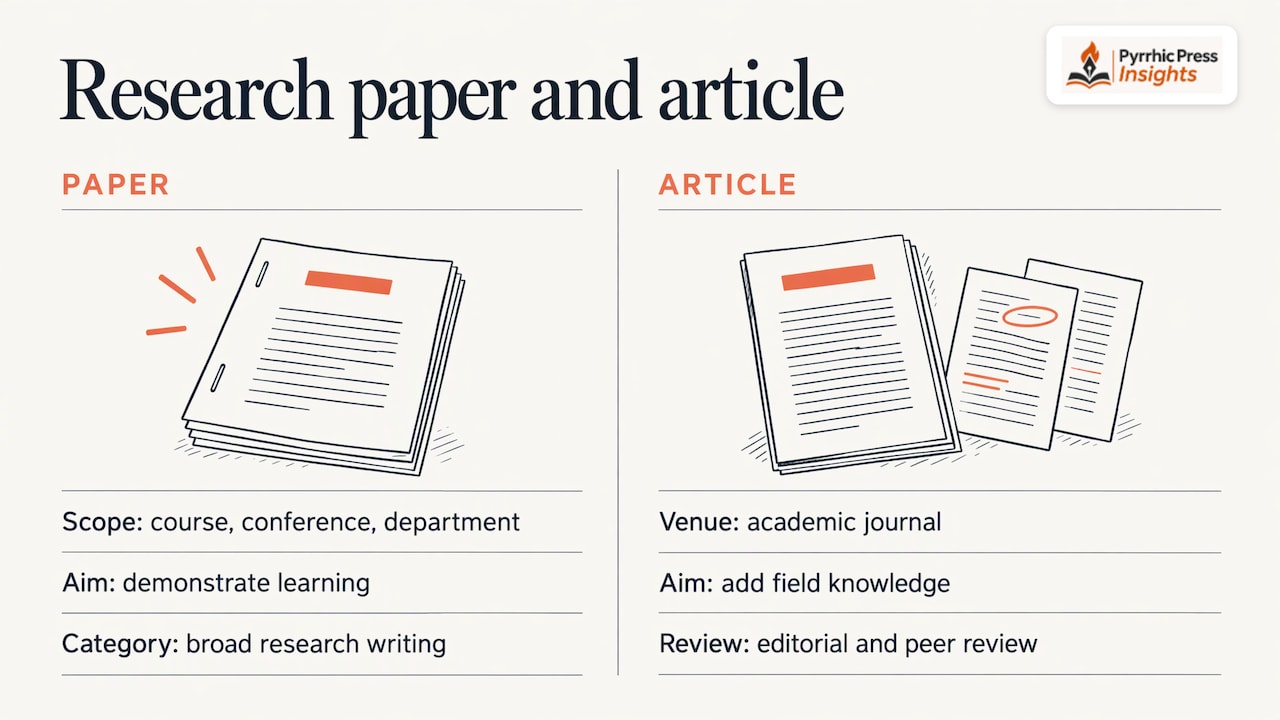
The two terms are often used interchangeably, but they are not identical. An academic writing resource from a German university puts it simply: all research articles are papers, but not every paper is a research article. A paper is the broad category, and it covers anything written from research for a course, a conference or a departmental requirement. An article is a paper that has been formatted and submitted to an academic journal, and ideally accepted.
A practical consequence follows. Papers often demonstrate that the writer has learned a method or understood a literature. Articles aim to add something new to what a field knows, and they must survive editorial screening and peer review. Lund University's academic writing guide quotes the linguist John Swales, who describes the research article as a text of usually a few thousand words that reports an investigation carried out by its authors and relates the findings to other people's work. Because most research articles are written for refereed journals or edited volumes, the same guide notes, they are shaped by the effort to become accepted for publication. The review process is part of what defines the genre.
If you are a student, this means a class paper can become an article, but usually only after reframing it around a contribution rather than a demonstration of learning.
The three families: empirical, theoretical and review
The Galvin Library at the Illinois Institute of Technology sorts research papers into three types. This is the most useful starting classification, because it tells you what the paper does.
Empirical papers
An empirical paper reports original findings from data you collected or analyzed yourself, through experiments, surveys, interviews, observation or archival work. Its structure is typically IMRaD: Introduction, Methods, Results and Discussion. A Florida Atlantic University guide explains that a central aim of this structure is to give readers enough information to reproduce the study. Redoing a study may confirm the findings and so give them validity, or it may reveal shortcomings, and inconsistent replication results point to a gap in knowledge that later studies must address.
That is why the methods section matters as much as the results. If another researcher cannot see what you did, they cannot check it. Writers who want help organizing the research behind such a paper may find a guide on using AI for essay research useful during the early reading and note-taking stage, though the design, analysis and interpretation remain yours.
Common empirical designs include experimental studies, cross-sectional studies, cohort and case-control studies, and clinical trials. A Columbia University Medical Center library guide lists these as the usual categories of original research in the health sciences.
Theoretical papers
A theoretical paper develops or analyzes a framework, model or concept without collecting new data. The IIT guide describes a typical structure: an introduction with a theoretical focus, background or literature review, theoretical analysis, applications and implications, and a conclusion. Umeå University's library notes that theoretical articles develop new theories or methods rather than reporting new data. Philosophy, mathematics, economics and many social science fields publish a great deal of this kind of work.
Review papers
A review paper synthesizes existing research, usually organized by theme or in chronological order, and identifies gaps and trends. Several variants exist. A narrative literature review offers a broad, interpretive overview. A scoping review maps the extent of research on a topic. A systematic review follows a defined protocol to find and appraise all relevant studies. The University of Michigan Library's scholarly publishing guide places these under the heading of full articles, alongside original reports.
Reviews are useful for readers who need an overview, though the German writing guide cited above points out that they can lack the very latest results. For early-career researchers, a well-built review is a legitimate way to enter a field, because it shows command of the literature and sets up later original work.
Types of papers you write for courses
Students meet a different vocabulary. The University of Michigan Press describes two basic types of research paper in its introduction to the research process. A report paper gathers information from several sources and presents it in an organized way without personal opinion, which is common in undergraduate courses. An argument paper uses sources to support the writer's own position, making judgments and presenting facts in support of an overall claim. The press notes that this second mode is the one scholarly work uses to communicate new perspectives.
Southern Methodist University Libraries offers a more granular list by purpose:
| Paper type | Purpose |
|---|---|
| Academic argument essay | Persuade through logic, evidence and analysis |
| Analytical essay | Break an issue into components and discuss them objectively |
| Opinion essay | Persuade through logic or emotional appeal |
| Literature review | Synthesize research to give context and show originality |
| Annotated bibliography | List citations with annotations, often a step toward an essay |
| Expository essay | Explain a topic, typically without extensive research |
These labels explain much of what search results call experimental, analytical, argumentative, definition or survey papers. The names differ between instructors, but the question underneath is constant: is the paper reporting, explaining, analyzing or arguing? Once you can answer that, you can follow any assignment brief.
Students who want their work read beyond the classroom have a clear path. A strong argument paper or literature review can be revised into a journal-ready manuscript, provided it adds a contribution and follows the target venue's formatting rules.
Publication types inside a journal
Once a manuscript is aimed at a journal, the vocabulary changes again. Journals define their own article types, and submitting to the wrong one is a common reason for early rejection. The most frequent are these.
Original research articles. Reports of original empirical research. The NIHR Mental Health Research Network guide calls the original article the most common type and the carrier of new knowledge.
Case reports. The same guide describes a case report as an account of a single case with unique features, such as a new instance of a disease or an unusual response to treatment.
Review articles. In the words of a South African academic publishing guide, these are comprehensive, authoritative descriptions of a subject within a journal's scope, often commissioned from experts with an educational aim.
Short communications and letters. The University of Michigan guide describes letters or brief communications as a route for the timely release of important results. Brevity allows rapid publication on current topics.
Editorials and commentaries. The South African guide explains that editorials are short pieces by editorial board members on policy issues relevant to the journal, while commentaries are short, focused, opinionated articles on a contemporary issue within scope. Neither reports new data.
Conference proceedings. According to the Michigan guide, these suit partially finished or ongoing research presented to a community before it is ready for a full article.
A second family of academic outputs sits beside journal articles: theses, dissertations, research reports and technical reports. They are valuable records of scholarship, though they usually follow institutional rather than journal rules.
How conventions differ by field
The weight given to each type varies across disciplines. Umeå University's library notes that researchers in medicine commonly publish journal articles, while in the humanities they more often write books, known as monographs, or chapters in edited anthologies. Many scholarly articles follow IMRaD, plus references and usually a short abstract. Others, particularly in the humanities and theoretical fields, are organized by argument instead.
This matters if you work across boundaries. A historian submitting to a science-style venue may be asked for a structured abstract and a methods section that her field does not use. A scientist writing for a humanities journal may find that narrative argument replaces the results section. Read two or three recent articles in your target venue and note their headings, length and citation style before you format your own.
Literary and creative work follows still different conventions: poetry, essays, spoken-word pieces and creative nonfiction have their own genres and rarely use IMRaD. Writers seeking a home for such work should look for a venue that publishes literature as seriously as scholarship.
What happens after you submit
The type you choose also shapes how your manuscript is reviewed. Umeå University's guide describes the usual sequence: authors submit a draft, an editor screens it, reviewers assess its quality and suggest changes, and the cycle repeats until the editor accepts or rejects it. Reviews may be blind or double-blind, and double-blind review is seen as reducing the risk of bias and discrimination.
A short communication will usually move faster than a full review article, and an editorial may be commissioned rather than peer-reviewed. Our own peer review and editorial process page explains how we handle submissions, and our publication ethics and research integrity page sets out the standards authors and reviewers are asked to follow, including how conflicts of interest are handled.
Choosing the type that fits your work
A simple sequence of questions will place most manuscripts.
- What is the contribution? New data points to an original article or, if brief and urgent, a short communication. A new framework points to a theoretical paper. A synthesis of existing studies points to a review. A single unusual case points to a case report. A position on a current debate points to a commentary.
- How much material do you have? A few thousand words of tightly reported findings is a normal article. Less may suit a letter. A book-length argument belongs in a monograph.
- Who needs to read it? Researchers in your field expect the conventions of their journals. Practitioners and the public may be better served by a clear, openly available version.
- Is the work finished? Ongoing studies fit conference proceedings or working papers. Completed studies with full methods belong in an article.
- Can others verify it? If your paper reports data, make the methods detailed enough to be reproduced, in line with the reproducibility aim described above.
Write your answer to each question in a single sentence before you draft. If the sentences point to different types, your project may be two papers rather than one.
Where open access fits
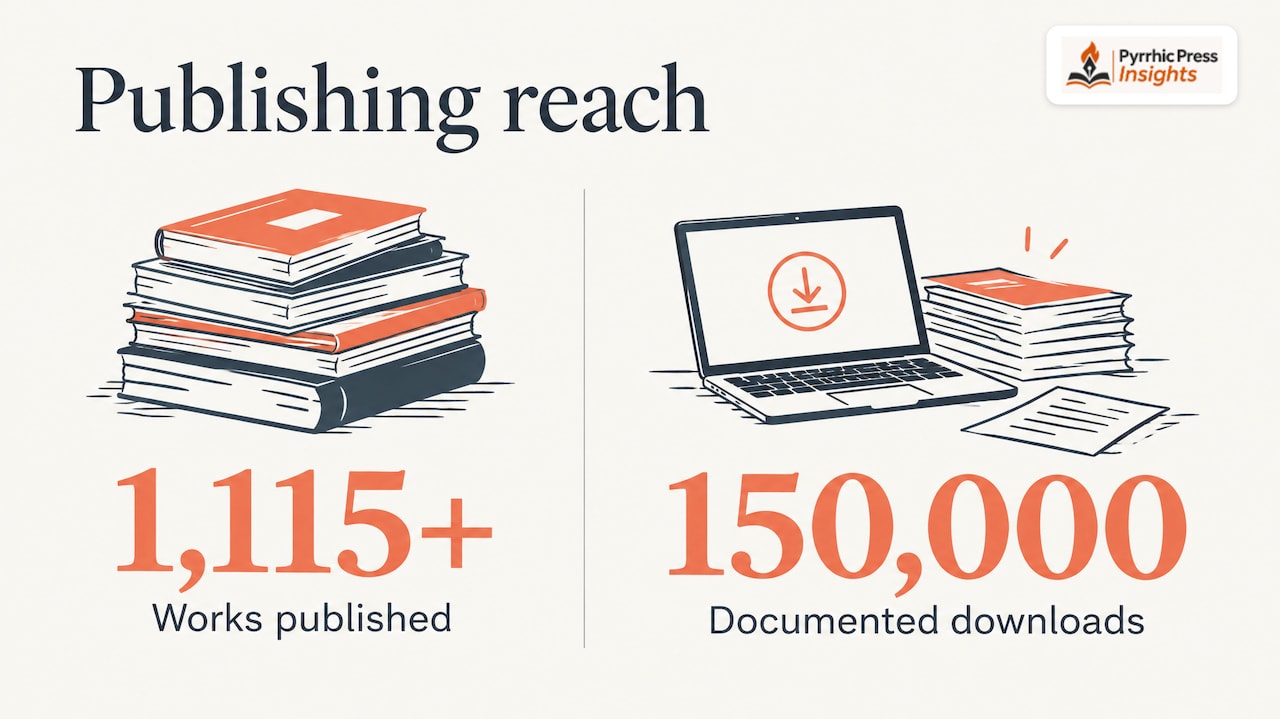
Format is only half the decision; access is the other half. A paper behind a paywall reaches fewer readers, and fees charged to authors can put publication out of reach for independent researchers and students. We built Pyrrhic Press Publishing to remove that obstacle: we publish scholarly works without submission or publication fees, and our catalog includes journals, books, poetry, spoken-word performances and professional development webinars. We have published over 1,115 works, with 150,000 documented downloads.
To see how different projects have moved from manuscript to publication, read our publishing and scholarly research case studies. To look at what we publish and how to submit, start from our journals page, and read our publishing policies and editorial standards before preparing your manuscript.

We also run a Free Author Spotlight, which gives authors visibility for their work, and the 3PO Index, a framework for evaluating transparency and openness in academic publishing. You can explore Pyrrhic Press Publishing to see the full range of services, all of which are free to authors and readers. For a closer look at how platforms are assessed, see the 3PO Score Index, and for a guide to selecting trustworthy venues, read our article on how to avoid predatory journals and publish ethically.
Our perspective
We see the choice of paper type as the first editorial decision an author makes, and it is better made deliberately than by default. A manuscript that knows what it is, whether an original study, a theoretical argument, a review or a short report, is easier to review, easier to improve and easier for readers to use.
We also believe that format should never be decided by what an author can afford. Independent researchers and emerging voices often produce careful, original work that does not fit the pattern of well-funded institutions. Our commitment to publish scholarly works without submission or publication fees is meant to ensure that the type of paper an author chooses is the one that serves the work, not the one that fits a budget.
This is why we pair open access with transparent standards. Our peer review and ethics pages state what authors can expect, and our 3PO Index offers a way to evaluate how open and transparent a publishing platform is. International, interdisciplinary exchange is stronger when the rules are clear and the doors are open to all who do the work.
the author
FAQ
What are the main types of research papers?
The three broad types are empirical papers, which report original findings, theoretical papers, which develop or analyze frameworks, and review papers, which synthesize existing research. Course assignments add report papers and argument papers. Journals then divide articles into original research, reviews, short communications, case reports, editorials and commentaries.
Is a research article the same as a research paper?
Not quite. A research paper is any academic work based on research, including course papers and conference papers. A research article is formatted for and submitted to a peer-reviewed journal. Every research article is a paper, but a paper only becomes an article when it is prepared for publication and reviewed.
What is the IMRaD structure?
IMRaD stands for Introduction, Methods, Results and Discussion. It is the standard layout of empirical articles in many fields, plus an abstract and references. Its purpose is to give readers enough detail to understand and, where possible, reproduce the study.
Do all disciplines publish the same types of papers?
No. Medicine and the sciences rely heavily on journal articles, while the humanities more often use monographs and book chapters. Always check the recent issues of your target journal or publisher to see which article types and structures it accepts.
Can a student paper be published?
Yes, if it contributes something new and is reshaped for the target venue. A course paper that demonstrates learning usually needs reframing around its contribution, a fuller methods or argument section, and the formatting the venue requires. Students and independent researchers can submit to Pyrrhic Press Publishing without any submission or publication fee.
Sources
- What Is an Academic Article? Online Writing Lab
- Research Articles (RAs), Academic Writing in English, Lund University
- Structure of a Scholarly Article, Florida Atlantic University Libraries
- Research Papers and Articles, Galvin Library, Illinois Institute of Technology
- Pursuing Publications: Overview and Considerations, Columbia University Medical Center
- Publishing an Article, University of Michigan Library
- Introduction to the Research Process, University of Michigan Press
- Types of Research Papers, Southern Methodist University Libraries
- NIHR Mental Health Research Network guide to finding and reading research
- Academic Publishing guide, SABSA
- Scholarly articles and other publications, Umeå University Library