Publishing an academic book means preparing a proposal or manuscript, finding a publisher whose subject list fits your work, passing peer review, signing a contract and moving through editing and production. For independent researchers, students and writers, the decisive question is who pays for that work. At Pyrrhic Press Publishing, scholarly works are published without submission or publication fees, so the route to a book does not depend on a grant, an institutional budget or a personal payment.
This guide walks through the full process, explains what to check at each stage, and shows how a no-fee open-access route fits into it.
TL;DR
- An academic book typically moves through proposal, peer review, contract, editing, production and release. Requirements differ by publisher, so each press's own instructions come first.
- Choose a publisher for subject fit, readership, peer-review practice, editorial support, rights terms and access costs, not for reputation alone.
- Publishing a scholarly book without author charges is possible. Pyrrhic Press Publishing publishes scholarly works without submission or publication fees.
- Before signing anything, check copyright retention, the open license, royalty terms and any processing charges.
Table of Contents
- What publishing an academic book involves
- Step 1: Define the book and its readers
- Step 2: Choose a publisher on criteria, not on name
- Step 3: Prepare a proposal that matches the press
- Step 4: Peer review and revision
- Step 5: Contract, editing and production
- Can you publish a scholarly book for free?
- What about textbooks?
- Perspective
- Publishing with Pyrrhic Press Publishing
- A short pre-submission checklist
- FAQ
- Sources
What publishing an academic book involves
An academic book is a scholarly monograph (a book-length study by one or a few authors), an edited collection, or a textbook, usually written for a research or teaching readership rather than the general public. Its path differs from that of a journal article in length, timeline and the number of people who shape it.
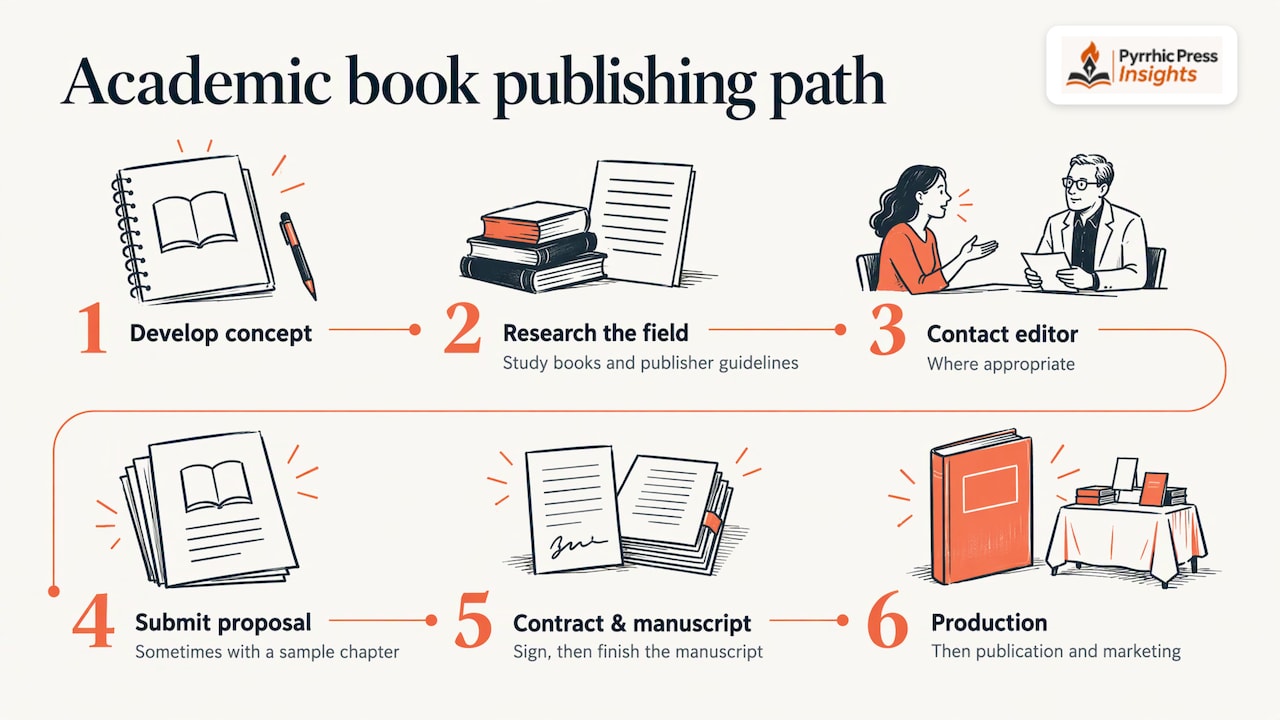
A library guide from UCSF describes the sequence this way: develop the concept, study the books in your field and the publishers' submission guidelines, contact an acquisitions editor where appropriate, and submit a proposal as the publisher instructs, sometimes with a sample chapter. If the press accepts, you sign a contract, finish the manuscript with your editor, and the book moves to production, publication and marketing. The same guide notes that proposal requirements differ by publisher and that an initial response may take one to three months. Treat any generic checklist, including this one, as a map and the press's own page as the rule.
Step 1: Define the book and its readers
Before approaching any publisher, write down three things: the argument of the book in two sentences, the readers who will use it (researchers in a subfield, students in a course, a wider public), and the books it most resembles. Editors read proposals against exactly these questions.
If the book grows out of a dissertation, expect to reshape it. A dissertation answers examiners; a book answers readers who have not agreed to read it. That usually means a stronger opening argument, a lighter literature review and a structure built around the reader's questions instead of the committee's requirements.
Creative and literary authors face the same discipline in a different form. A poetry collection or a work of creative nonfiction still needs a clear statement of what it is, who it is for and how it differs from comparable titles.
Step 2: Choose a publisher on criteria, not on name
Monash University's publisher-selection guide advises building a shortlist from subject fit, intended readership, discipline norms, distribution reach, editorial support, review policy and access costs, and cautions against treating reputation alone as a quality proxy. In practice, ask each candidate press the following:
| Question | What a good answer looks like |
|---|---|
| Does the list fit your subject? | Recent titles sit near your topic and discipline. |
| Who reads its books? | The press can name its audience and how readers reach the work. |
| How is quality assured? | A published peer-review and editorial policy. |
| What does it cost you? | Charges are stated plainly, or there are none. |
| What rights do you keep? | Copyright and license terms are explicit before you sign. |
| How long does it take? | A realistic timeline from acceptance to release. |
The Chronicle's guide by editor Rebecca Colesworthy, How to Approach a Book Editor (January 30, 2024), makes a point worth remembering: fit is mutual. Editors weigh their existing lists and market access, and authors should weigh whether a press's process and support meet their own needs.
Check the credentials of any open-access publisher
Open access means the finished work is free for anyone to read online. The OA Books Toolkit states that open access does not determine scholarly quality: reputable open-access publishers can apply rigorous review, and authors should look at peer-review and editorial credentials. It points to directories such as DOAB and Think, Check, Submit for this purpose. Our guide on how to avoid predatory journals and publish ethically applies the same logic to a publisher's claims about review, fees and indexing.
Pyrrhic Press Publishing sets out its approach in public. Its publishing policies and editorial standards and its peer review and editorial process pages let an author read the terms before submitting anything.
Step 3: Prepare a proposal that matches the press
Proposals commonly include an overall description, a chapter outline, a market analysis with comparable titles, a timeline and specifications such as length and illustrations, according to the Chronicle guide. The same article stresses that press-specific instructions take precedence over any template. A workable preparation routine:
- Write the description. One to two pages on the argument, the contribution and the readership.
- Outline the chapters. A paragraph per chapter, showing how each advances the argument.
- Name comparable titles. Three to six recent books, and a sentence on how yours differs.
- State the practicalities. Estimated word count, figures or tables, completion date, and whether the manuscript is finished or in progress.
- Prepare a sample chapter. Usually the introduction or the strongest empirical chapter.
- Read the submission page again. Match file format, order and length to the letter.
A proposal that follows instructions signals that the finished manuscript will also be handled with care. A proposal that ignores them is often set aside without a close reading.
Step 4: Peer review and revision
As Georgetown University Library explains, scholars review the work and editors use their reports to guide revision. Depending on the press, subject and manuscript, a book may be reviewed two, three or four times, and revised manuscripts may go back to the original or to additional reviewers.
The University of Illinois library guide adds that review may begin with a proposal and sample chapters or with a full manuscript, and that authors should expect at least several months before reports arrive. After that come your written response, revisions, a possible second review, approval by the press's faculty board, delivery of the final manuscript, then copyediting, layout, proofreading, cover design, printing and marketing.
When reports arrive, a few habits make the revision stronger:
- Respond to every point, even when you decline a suggestion, and explain the reasoning.
- Separate requests that change the argument from those that change the presentation.
- Disclose any conflicts of interest in your relationship to reviewers or to the subject, and follow the press's rules on anonymity.
Peer review is best understood as a method for strengthening scholarship. A reader who has pressed on your weakest chapter has given you the chance to fix it before the public does.
Step 5: Contract, editing and production
Once a manuscript is accepted, the contract sets out what you grant the publisher and what you keep. The Society of Authors' guidance on publishing contracts advises examining the scope of rights, territory, language, formats, the duration of the license, termination and how royalties are calculated, and weighing those terms against the publisher's investment and services.
For an open-access book, add three checks from the OA Books Toolkit: any institutional or funder open-access requirement that applies to you, whether you retain copyright, and which Creative Commons license will govern reuse. Creative Commons licenses set out how others may share, reuse and build on the work, so the choice of license is a choice about how far your book travels.
Production timelines are longer than most first-time authors expect. Georgetown's guide says production can take 6 to 18 months, with contract milestones such as delivery of the final manuscript. Copyediting, proofs and indexing come before print and ebook files are made.
Formats, ISBNs and discoverability
Digital formats such as PDF, HTML, EPUB and Kindle each have different advantages and accessibility features, and the OA Books Toolkit lists metadata and persistent identifiers such as DOI and ORCID as part of how a book gets found. A book with complete metadata and a permanent identifier is easier to cite and to locate years later. Our page on research preservation, metadata and publication practices explains how Pyrrhic Press Publishing approaches this.
Can you publish a scholarly book for free?
Yes, and the question matters because charges at this level are substantial. The 2022 VU Amsterdam Open Access Books Guideline gives a range of €7,000 to €15,000 for gold open-access book-processing charges, the fee model in which an author or funder pays for the book to be free to read. Independent researchers and students rarely have that money, and many institutions cover it only for some authors.
The alternative is diamond open access, which the same guideline describes as charging neither authors nor readers, funded by universities, libraries, governments and other supporters. The Bodleian Libraries list diamond schemes among the routes that do not charge authors, alongside funder support, crowdfunding, flip-to-open models and depositing permitted material in a repository.
Pyrrhic Press Publishing belongs in this first group. Our core commitment is to publish scholarly works without submission or publication fees, and we are supported by donations, grants and institutional sponsorship instead of author payments. Authors and readers both use the press at no charge. For a closer look at charges across the industry, see our guide to academic publishing fees and how to avoid them.
Funder mandates are a separate matter. The Bodleian page notes that UKRI-funded monographs, chapters and edited collections published from January 1, 2024 must be open access within 12 months, and that UKRI funding can cover eligible charges up to £10,000 including VAT per book and £1,000 including VAT per chapter, subject to eligibility and approval. Authors funded elsewhere should read their own funder's policy in the same way.
What about textbooks?
Textbooks are written for course use and are usually shaped around a syllabus, a market size and an adoption plan, so a proposal for one leans more heavily on course enrollment, level and competing titles. If your goal is a freely available teaching text, an open-access route lets students read it without cost; the proposal still needs the audience, outline and comparable-titles sections described above.
Perspective
We built Pyrrhic Press Publishing on a simple observation: the people with the most to say are often the people with the least access to a publisher's budget. An independent researcher, a graduate student or an emerging writer should not have to find thousands of dollars before a reader can see the work.
Our model is therefore openness at both ends. We publish scholarly works without submission or publication fees, and readers reach them without payment. With more than 1,115 published works and 150,000 documented downloads, we see what that openness does for visibility: work that is free to read is work that gets read.
Openness is not a substitute for rigor. Our published standards describe editorial screening and peer review, and our 3PO Index offers a framework for evaluating transparency and openness in academic publishing, so authors can judge any venue, including ours, against clear criteria.
the author
Publishing with Pyrrhic Press Publishing
If you are an independent researcher, a student or a writer looking for an open-access home for a book, poetry collection or other scholarly or creative work, start on the Pyrrhic Press Publishing home page. Our open-access publishing carries no submission or publication fees, and the Free Author Spotlight gives authors a place to present their work to readers. You can also read our scholarly publishing standards before you decide.

For related reading, our guide to academic book publishing routes, costs and how to choose goes deeper on the decision, and how to publish a research paper covers the article route. The 3PO Score Index lets you compare publishing platforms on transparency and openness.
A short pre-submission checklist
- The press's submission instructions are open beside your proposal, and every item is matched.
- You have read its peer-review and editorial policy.
- You know exactly what you will be charged, if anything, and when.
- You know who holds copyright and which license applies.
- You have noted any funder or institutional open-access requirement.
- Your manuscript carries complete metadata, and you have an ORCID iD for identification.
FAQ
How long does it take to publish an academic book?
Expect an initial response to a proposal within one to three months at many presses, then several months for peer-review reports. After the final manuscript is delivered, production can take 6 to 18 months, according to the university guides cited above. Timelines vary by press, so ask for the schedule early.
Can I publish a scholarly book without paying anything?
Yes. Diamond open-access models charge neither authors nor readers, and Pyrrhic Press Publishing publishes scholarly works without submission or publication fees. Always confirm the terms in writing and read the contract before signing.
Do I need an agent or an acquisitions editor to get started?
For academic books you generally approach the press directly, often by contacting an acquisitions editor or following the submission page, and you send a proposal in the format the press asks for. An agent is not part of the usual scholarly route.
Is an open-access book less respected than a print book?
Quality depends on the review and editorial practice behind a book, not on whether it is free to read. The OA Books Toolkit states that open access does not determine scholarly quality, and reputable open-access publishers apply rigorous review. Choose a press whose review process is published and clear.
Can I keep the copyright to my book?
Often yes, but it depends on the contract and the license. Check who holds copyright and which Creative Commons license applies before you sign, and compare the terms with any funder or institutional requirement.
Sources
- Book writing & publishing, UCSF Library
- Choosing a book publisher, Monash University
- Publishing OA books, OA Books Toolkit
- How to Approach a Book Editor, The Chronicle of Higher Education
- Scholarly Publishing at Georgetown: Publication Process
- Next Steps, Dissertation to Book, University of Illinois
- Publish a book or book chapter open access, Bodleian Libraries
- Open Access Books Guideline, VU Amsterdam
- Guidance on Publishing Contracts, Society of Authors